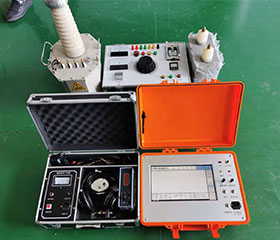
Main Features:
Underground Cable Fault Detector
The cable fault tester has the following notable features:
1. Comprehensive functions, safe, rapid, and accurate fault testing. The instrument uses the low-voltage pulse method and high-voltage flashover method for detection, capable of testing various cable faults. For flashover and high-resistance faults in power cables, it can directly test without burning through. If equipped with an acoustic point locator, it can accurately determine the fault point location.
2. High testing accuracy. The instrument adopts high-speed data sampling technology with a reading resolution of 1m. High intelligence level. Test results are automatically displayed on a large-screen LCD in small graphics and data, making fault judgment intuitive. It also features menu-driven operation, requiring no special training for operators.
3. Waveform and parameter storage and recall functions. Using non-volatile devices, waveforms and data are not lost after power-off.
4. Dual-trace display function. It can compare the test waveform of the faulty cable with a normal waveform, facilitating further fault judgment.
5. Waveform expansion ratio function. Changing the waveform ratio allows expansion for precise testing.
6. Controlled measurement cursor, which can automatically search along the line and stop at the inflection point of the fault waveform.
Overview
Underground Cable Fault Detector
is a comprehensive cable fault detection instrument. It can test high-resistance flashover faults, high/low-resistance grounding, short circuits, cable breaks, poor contact, and other faults. If equipped with an acoustic point locator, it can accurately determine the precise fault location. It is especially suitable for testing various types of power cables and communication cables at different voltage levels.
System Composition:
1. Cable fault tester main unit
2. Cable path and fault locator
3. Integrated high-voltage generator for cable faults
4. Cable identifier
5. High-voltage cable safety piercing device
6. High-voltage equipment: current sampler, integrated high-voltage generator for cable faults, pulse capacitor, complete set of dedicated test leads, etc.
The cable fault tester is a comprehensive set of equipment. It is used for testing open circuits, short circuits, grounding, low-resistance, high-resistance flashover, and high-resistance leakage faults in power cables, as well as precise testing of open and short circuits in coaxial communication cables and local telephone cables. It can also test cable paths, burial depth, and perform radio wave speed measurement, verify cable length, and establish cable archives for routine maintenance and management.
Technical Parameters:
Underground Cable Fault Detector
1. Test distance not less than 10 kilometers.
2. Fault point positioning error less than 0.5 meters.
3. Cable path detection not less than 10 kilometers.
4. Main unit initial test error less than 2%.
5. Main unit power supply: AC 220V 50HZ ±10%
6. Main unit dimensions: 350×250×220 (mm)
7. Main unit weight: 5 kg
8. Locator power supply: DC 9V
9. Locator dimensions: 170×135×60 (mm) (excluding probe and earphones)
10. Locator weight: 0.5 kg (excluding probe and earphones)
Path and Fault Locator:
It consists of a transmitter, a receiver, an inductive probe, and a potential difference detection frame. The instrument uses electromagnetic induction methods for route tracing and depth testing of optical cables and cables, and uses potential difference methods for fault location testing of optical cables and cables. It is suitable for locating routes, depths, and points of poor insulation to ground in various optical cables and cables with metallic conductors (wire pairs, sheaths, shielding layers). It is a dedicated line fault tester for postal and telecommunications systems, as well as railway, mining, oilfield, airport, and shipping units.
Parameters:
← Previous
Live Cable Path Locator
Next →
Cable Outer Sheath Fault Tester
Yangzhou Darui Electric Co., Ltd.
主营产品:Dielectric Loss Tester、Transformer Ratio测试仪、Loop Resistance Tester、高压None线核相仪、Insulation Resistance Tester、Partial Discharge Tester、Cable Fault Tester、DC Resistance Tester等。
☎ Phone: 18952707000(关经理)📞 Landline: 0514-88770377✉ Email: 195214804@qq.com