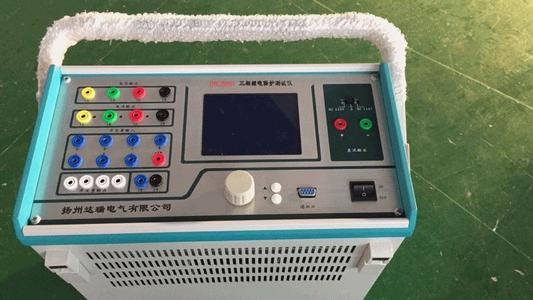
How to conduct AC tests with a microcomputer relay protection tester? As a high-voltage electrical device frequently used by power workers, the microcomputer relay protection tester has many features such as fast testing speed, high accuracy, and powerful functions. It has always been a handy device favored by power workers, especially when conducting AC tests with it. This article takes the YTC1000microcomputer relay protection tester as an example to briefly explain how to conduct AC tests with a microcomputer relay protection tester.
The "AC Test" module is a general-purpose, comprehensive testing module. It has independent 4-phase voltage and 3-phase current test units, independent 6-phase voltage and 6-phase current test units, a unique 12-phase simultaneous output unit, and a sequence component output test unit. Switching between them is done through the 3P, 6U, 6I, 12P, and sequence component buttons on the interface. These independent units can call each other, fully meeting AC test requirements under various power system conditions.
Their common feature is: by setting the corresponding voltage or current as a variable, assigning a certain step size to the variable, and selecting an appropriate test mode (there are three test modes: "Manual", "Semi-automatic", and "Fully automatic"), it is convenient to test the action value, return value, action time, and return time of various voltage and current protections, and automatically calculate the return coefficient. Since the most commonly used unit is the "four-phase voltage and three-phase current" unit, and the others are basically similar in usage, the following detailed introduction will take the "four-phase voltage and three-phase current" as an example.

It can flexibly control the output of 4-phase voltage and 3-phase current, 6-phase voltage, 6-phase current, and 12-phase simultaneous output in various combinations.
It has a sequence component output function, allowing direct setting of sequence component values, automatically combining the output of each phase voltage and current, and performing variable output according to sequence components.
The amplitude and phase of each phase voltage and current output can be set arbitrarily, and the amplitude can be set with an upper limit.
The amplitude, phase, and frequency of each quantity can be set to change, and the step size can be set arbitrarily.
Ux can be set to multiple output mode combinations, and can also be set to any value.
It can change fully automatically, semi-automatically, or manually, and can switch arbitrarily during output.
In the output state, the amplitude, phase, step size, and the number of variables can be directly modified.
It can directly display power values for calibrating power metering instruments.
It can measure action value, return value, action time, and return time.
The methods of conducting AC tests withmicrocomputer relay protection testers produced by different manufacturers are similar. In actual work, power workers need to first read the product manual carefully and conduct tests strictly according to the instructions to achieve the instrument's expected testing accuracy.