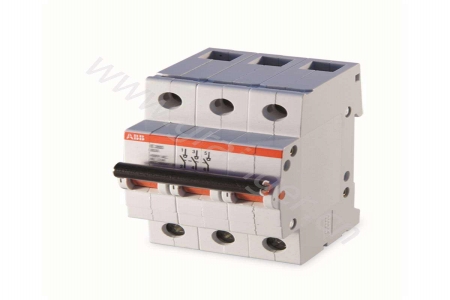
A disconnecting switch is a common electrical device inhigh-voltage switchgear. Its function is to disconnect circuits without load current, providing a clear disconnection point between the equipment under maintenance and the power source to ensure the safety of maintenance personnel. Disconnecting switches do not have dedicated arc-extinguishing devices and cannot interrupt load currents or short-circuit currents. Therefore, they can only be operated when the circuit breaker has already opened the circuit.
(1) Before operation, ensure that the circuit breaker is in the corresponding open or closed position to prevent pulling or closing the disconnecting switch with load.
(2) During operation, if serious defects such as severely damaged insulators or severely damaged transmission rods of the disconnecting switch are found, do not proceed with the operation.
(3) If the disconnecting switch makes abnormal sounds, identify the cause before proceeding; do not force open or close it.
(4) When interlocking devices to prevent misoperation are installed between disconnecting switches, earthing switches, and circuit breakers, switching operations must be performed in sequence. If the operation is blocked by the interlock, identify the cause; under normal circumstances, do not arbitrarily release the interlock.
(5) If the disconnecting switch and earthing switch cannot be operated correctly due to interlock device malfunction, strictly check the position status of the corresponding circuit breakers and disconnecting switches according to the interlock requirements. Only after verification can the interlock be released for operation.
(6) After releasing the interlock, operate quickly and decisively in the specified direction. Even if a load is accidentally closed, do not return to the original state to avoid expanding the accident, but do not use excessive force to prevent damaging the disconnecting switch. For single-pole disconnecting switches, when closing, close the two outer phases first, then the middle phase; when opening, reverse the order.
(7) Opening and closing disconnecting switches with load and no-load current should comply with relevant regulations.
(8) For disconnecting switches with remote control operation, operations should generally be performed in the main control room. Only when remote electrical operation fails, with permission from the station head and technical supervisor, and under on-site supervision, can local electric or manual operation be performed.
(9) After remote control operation, check the actual position of the disconnecting switch to avoid refusal to open or close due to faults in the control circuit or transmission mechanism, and also check whether the contacts are fully engaged.
(10) If insulator fracture is found in the disconnecting switch, open the corresponding circuit breaker according to regulations.
(11) During operation, wear a safety helmet, insulating gloves, and insulating boots.
(12) After operating the disconnecting switch, lock the anti-misoperation interlocking device to prevent future misoperation.