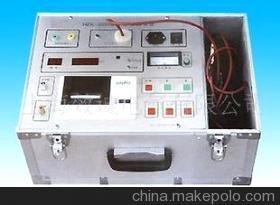
The main function of the vacuum degree tester is to measure the ion current inside the vacuum interrupter based on the magnetic discharge method, thereby measuring the vacuum degree inside the interrupter, and it can also be used to evaluate the service life of the vacuum interrupter. This tester can be used both in the factory inspection line for vacuum interrupters and for standalone measurements.
Basic Working Principle
The basic principle of measuring vacuum degree by the magnetic discharge method is as follows: the two contacts of the vacuum interrupter are separated by a certain gap and placed inside a solenoid carrying a large current. A high-voltage pulse is applied between the two contacts, thereby generating a high-voltage electric field and an axial pulsed magnetic field inside the vacuum interrupter. Under the action of the pulsed strong magnetic field and strong electric field, electrons in the vacuum interrupter move in a spiral motion and collide with residual gas molecules, causing ionization. The generated ion current is approximately proportional to the residual gas density, i.e., the vacuum degree.
The developed tester can measure three current values: leakage current, total current, and ion current.
(1) Leakage current. When the moving and stationary contacts of the vacuum interrupter are separated by a certain distance and a high-voltage DC pulse is applied, a strong electric field is generated between the two contacts and between the contacts and the shield. According to the field emission theory, electrons are emitted from the cathode and shield surfaces, moving toward the anode, forming a current, which is the leakage current. Since the mean free path of electrons is much larger than the distance between the two contacts, electrons hardly collide with residual gas molecules inside the vacuum interrupter, so the leakage current cannot accurately reflect the vacuum degree of the interrupter.
(2) Total current. In order to make the electrons of the leakage current collide with residual gas molecules, a common method currently used is to apply a strong magnetic field in the axial direction, causing the field-emitted electrons to move in a spiral motion under the combined action of the electric and magnetic fields. This increases the travel distance of electrons and the probability of collision with residual gas molecules. When electrons collide with residual gas molecules, ionization occurs, forming a stable self-sustaining discharge. At this time, the measured current value is the total current.
(3) Ion current. The measured total current includes the leakage current emitted from the cathode and shield, as well as the ion current generated by ionization after collision with residual gas. In order to accurately measure the vacuum degree inside the vacuum interrupter, the leakage current value must be subtracted from the total current to obtain the ion current value that truly reflects the vacuum degree of the interrupter. Principle for evaluating the service life of vacuum interrupters: as the vacuum interrupter is used over time, the internal vacuum degree increases linearly. By measuring the vacuum degree at two appropriately spaced intervals, its rate of change can be determined, thereby determining the vacuum degree of the interrupter after any period of use.