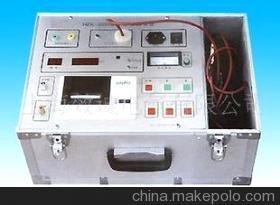
Pull the two contacts of the arc extinguishing chamber apart to a certain opening distance, apply pulsed high voltage; place the arc extinguishing chamber inside a spiral coil or place a new type of electromagnetic coil outside the arc extinguishing chamber, apply magnetic field voltage to the coil, thereby generating a pulsed magnetic field synchronized with the high voltage inside the arc extinguishing chamber. In this way, under the action of the pulsed magnetic field and strong electric field, electrons in the arc extinguishing chamber move in a spiral motion and collide with residual gas molecules to cause ionization. The resulting ion current is proportional to the density of residual gas (i.e., the vacuum value). For different types of vacuum tubes (tube types), due to their different structures, under the same contact opening distance, same vacuum degree, and same electric and magnetic field conditions, the magnitude of the ion current is also different. Through experiments, the corresponding relationship curve between vacuum degree and ion current for various tube types can be calibrated. After measuring the ion current, the vacuum degree of that tube type can be obtained by querying the ion current - vacuum degree curve for that tube type.
In the conventional magnetron discharge method for testing the vacuum degree of arc extinguishing chambers, in order to improve test sensitivity, it is necessary to remove the arc extinguishing chamber from the circuit breaker and place it inside a spiral coil. As a result, when the arc extinguishing chamber is reinstalled on the circuit breaker device, mechanical parameters need to be readjusted, which involves a large workload and requires professionals. Using a new type of magnetic coil can surround the arc extinguishing chamber from the side, so there is no need to disassemble the arc extinguishing chamber. At the same time, a single-chip microcomputer is used for synchronous control and data acquisition processing, which improves the on-site test sensitivity of the vacuum degree of the arc extinguishing chamber.