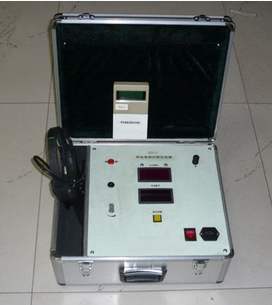
Wiring methods for the cable live line identifier: direct method and coupling method:
There are two wiring methods: direct connection and coupling. The direct connection method is only suitable for identifying unenergized cables, while the coupling method can accurately identify both energized and unenergized cables.
A) Direct method: Disconnect the ground wire of the cable to be identified. Connect the signal current output wire (red) to any good phase, and connect the other end of that phase to ground. Connect the signal current return wire (black) to ground.
Identification method: First, determine the phase. Use the initial deflection of the meter needle as the reference. According to the direction shown in the diagram, let the current flow through the receiving clamp in the indicated direction. If it is the cable to be identified, the initial deflection of the meter needle should be to the right. During phase determination, if multiple cables have the same phase, you can compare amplitudes. Adjust the sensitivity knob to a suitable position and compare amplitudes; the cable with the largest amplitude is the one to be identified.
B) Coupling method: Connect both ends of the cable to be identified to ground (via core wire, shield, or armor) to form a closed loop. When the direction of the output coupling clamp and the receiving coupling clamp are the same, the cable whose meter needle deflects positively is the one to be identified.
Identification method: Ensure the output coupling clamp and receiving coupling clamp are in the same direction. First, determine the phase. Use the initial deflection of the meter needle as the reference. According to the direction shown in the diagram, let the current flow through the receiving clamp in the indicated direction. If it is the cable to be identified, the initial deflection of the meter needle should be to the right. During phase determination, if multiple cables have the same phase, you can compare amplitudes. Adjust the sensitivity knob to a suitable position and compare amplitudes; the cable with the largest amplitude is the one to be identified