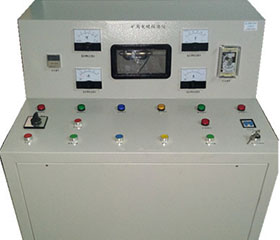
Mine Cable Fault Tester Main Features
This instrument consists of a current pulse transmitter, a receiver, a transmitting/receiving clamp, and several connecting wires. It features high-power current pulse output; clear field signal reception, portability, light weight, flexibility, high sensitivity, effective suppression of on-site power frequency interference, accurate and fast judgment; reliable protection circuit, not afraid of output short circuit; large clamp opening of φ150 suitable for power cables of various cross-sections; built-in high-power isolation transformer, ensuring no direct electrical contact between the operator and the mains. However, it is not allowed to touch the black and red clip wires with hands while the instrument is powered on.
Mine Cable Fault Tester Working Principle Introduction
Since live cables in operation are not allowed to have any grounding wires or other connecting wires damaged, nor is it allowed to directly apply the output signal of the identification transmitter to the cable phase wire carrying high voltage. Live cable identification needs to solve two difficulties: one is how to couple the cable identification signal onto the cable; the other is that the coupled signal is generally small, while the operating cable may have 50Hz unbalanced current, induced 50Hz interference current, and distributed capacitance current, which together constitute 50Hz power frequency electromagnetic interference. Therefore, the high-sensitivity receiving clamp must address the issue of how to resist 50Hz power frequency interference.
Our developed Live Cable Identifier uses microcontroller-based encoding and decoding technology in both the transmitter and receiver, as well as PSK technology widely used in the communication field. The transmitting clamp emits a phase-encoded signal with an average value of zero. The microcontroller in the receiving clamp filters the received signal through hardware and software filtering, and then performs phase identification. When the receiving clamp is clamped onto the cable in the direction of current flow, the current meter of the identified cable deflects to the right, accompanied by audible and visual indication. For other cables, the current direction is opposite to that of the identified cable, so the meter pointer deflects to the left, with no audible or visual indication. This demonstrates the uniqueness of the identified target cable. It is easy to distinguish the identified cable from multiple cables. Moreover, since the signal current intensity on the identified cable is consistent along the entire length, the electromagnetic signal strength received by the receiving clamp along the cable is uniform. In principle, the identification of the cable is not limited by the length of the cable being identified.
Performance Specifications
Transmitter
1. Maximum pulse peak output current: 20A
3. Power supply: AC220V(-10% to +10%), power consumption not exceeding 100W
4. Weight: not exceeding 12kg
Receiver
Receiver sensitivity: ground loop resistance less than 50 ohms
Operating Steps
1. Connect the transmitting source:
Insert the red and black plug connectors of the transmitting clamp A into the corresponding red and black binding posts on the transmitting source, and clamp the transmitting clamp A onto the cable to be identified. The arrow on the transmitting clamp A should point towards the cable terminal. Both ends of the cable to be identified should be reliably grounded. For cables not in operation, the core wires at both ends can also be grounded.
2. Turn on the power switches of the transmitting source and receiver to verify the direction:
On the cable to be identified, at a distance of more than two meters from the transmitting clamp, clamp the receiving clamp B onto the cable, ensuring the arrow on the clamp points towards the cable terminal. Then verify the current direction and test connection direction. At this time, the current meter pointer of the receiver must deflect to the right, accompanied by audible and visual indication. As shown in the figure. If the arrow of the receiving clamp B points towards the transmitting source end, there will be no audible or visual indication, and the current meter pointer will deflect to the left. Remember the deflection direction of the receiving clamp meter.
3. Identification: At the identification point, use the receiving clamp B to identify each cable. During identification, always keep the arrow on the receiving clamp pointing towards the cable terminal direction, and test each cable one by one. On the identified cable, the receiver current meter pointer must deflect to the right, accompanied by audible and visual alarm indication. On other cables, the receiver current meter pointer must deflect to the left, with no audible or visual alarm indication. The cable where the receiver current meter pointer deflects to the right with audible and visual alarm indication is the one to be found and identified. This test result is unique. That is, no matter how many cables are in the cable trench, when using the receiving clamp B to identify each cable, only one cable (the one to be found and identified) will have the receiver current meter pointer deflecting to the right with audible and visual alarm indication.