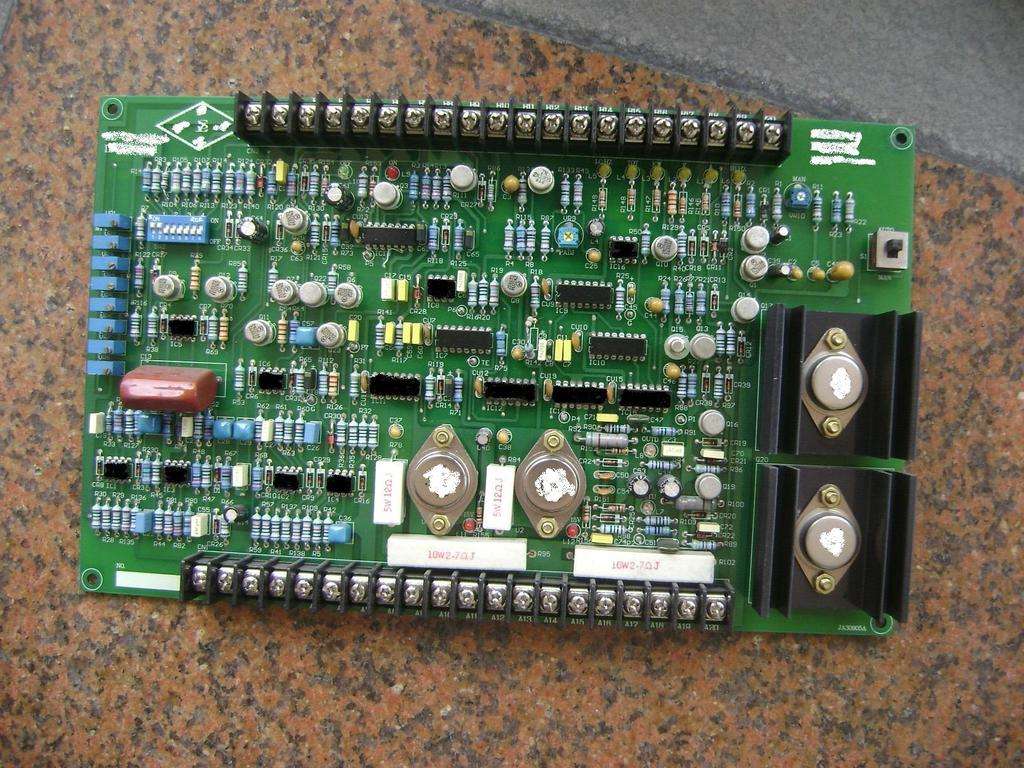
Medium frequency furnace series resonance control board
Medium frequency furnaces are divided into two types based on compensation: parallel resonance (current type) and series resonance (voltage type). So what is medium frequency furnace series resonance? And what does the medium frequency furnace series resonance control board look like?

The inverter used in the series resonance medium frequency furnace is a series resonance inverter, whose load is a series resonant load. It usually requires a voltage source supply. In a medium frequency furnace, the voltage source is typically composed of a rectifier plus a large capacitor. Due to the large capacitance, the input voltage of the inverter can be approximately considered constant. By alternately turning on and off the controllable devices on the inverter, an alternating square wave voltage can be obtained at the output of the inverter. Its voltage amplitude depends on the input voltage of the inverter, and the frequency depends on the switching frequency of the devices.
The power control process is as follows: the product of the inverter input voltage Ud and current Id is compared with the set value, the difference is input to the power regulator, and its output is compared with the current Id. After the current regulator operation, it controls the output pulse frequency of the voltage-controlled oscillator, changing the counter overflow pulse time, thereby changing the trigger pulse frequency of the thyristor, achieving the desired control effect. This control effect of the medium frequency furnace series resonance control board is reflected in maintaining constant input power under heavy load conditions above the furnace rated value; within the light load range below the rated value, it controls the output current within the limit value.
Characteristics of series resonant circuit:
The difference between the medium frequency furnace series resonance inverter and the parallel resonance inverter stems from the different oscillation circuits they use: the former uses L, R, and C in series, while the latter uses L, R, and C in parallel.