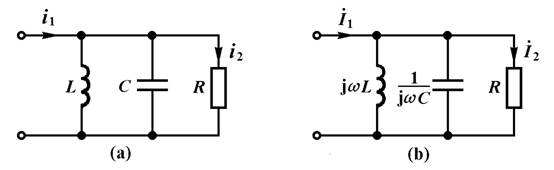
Parallel resonance characteristics: Parallel resonance is a complete compensation. The power supply does not need to provide reactive power, only the active power required by the resistance. During resonance, the total current of the circuit is minimal, while the branch current is often greater than the total current in the circuit. Therefore, parallel resonance is also called current resonance.
Parallel resonance is a complete compensation. The power supply does not need to provide reactive power, only the active power required by the resistance. During resonance, the total current of the circuit is minimal, while the branch current is often greater than the total current of the circuit. Therefore, parallel resonance is also called current resonance.
A typical common-emitter amplifier circuit composed of a transistor and resistor-capacitor components, with an RLC parallel resonant circuit as its collector load. Setting an appropriate static operating point makes the transistor work in the amplification state. The emitter resistor is a current sampling resistor, introducing deep current series negative feedback, which makes the output resistance seen from the collector very high. Therefore, the collector output current of the transistor can be regarded as an AC current source controlled by the input voltage.
This method effectively compensates for the lack of a suitable RLC parallel resonant circuit excitation source in the laboratory, and is very suitable for electronic circuit experimental teaching in universities. On one hand, it helps students deeply grasp the basic characteristics and applications of RLC parallel resonant circuits; on the other hand, it guides students to analyze using a combination of theoretical calculation and experimental verification.
<span style="font-family: " pingfang="" sc",="" "lantinghei="" "microsoft="" yahei",="" simhei,="" arial;="" font-size:="" 18px;"="">Second, parallel resonance is a complete compensation. The power supply does not need to provide reactive power, only the active power required by the resistance. During resonance, the total current of the circuit is minimal, while the branch current is often greater than the total current in the circuit. Therefore, parallel resonance is also called current resonance.So-called resonance, according to circuit theory, it is a sinusoidal voltage applied to an ideal (no parasitic resistance) inductor and capacitor in series. When the sinusoidal frequency is a certain value, the capacitive reactance equals the inductive reactance, the circuit reactance is zero, and the total current is determined by the voltage and resistance; if a sinusoidal voltage is applied to a parallel circuit of inductor and capacitor, when the sinusoidal voltage frequency is a certain value, the total susceptance of the circuit (susceptance is the reciprocal of reactance) is zero. The former is called series resonance, and the latter is called parallel resonance.